Local Partnership Ideas That Actually Grow Your Business
Local Partnership Ideas That Actually Grow Your Business

Start with one low-friction ask to a non-competing neighbor who serves your same customers. That single move, done this week, is the fastest path to new foot traffic and warm referrals. Local partnerships work best when both parties serve overlapping audiences but not the same customers. The goal is complementary, not competitive.
Here are the eight highest-impact local partnership ideas you can act on right now:
- Cross-promotion swap — trade social shoutouts or email mentions with a neighboring business
- Joint event or pop-up — co-host a one-day experience that draws both audiences
- Bundled offer — package your product with a partner’s service at a combined discount
- Referral agreement — formalize a simple lead-passing arrangement with a one-page document
- Charity tie-in — co-sponsor a local cause for shared PR and community goodwill
- Newsletter swap — feature each other in your next email send (zero cost, fast to execute)
- Space sharing — host a partner’s pop-up in your location on a slow day
- Co-branded seasonal experience — create a limited-time package tied to a local event or holiday
Your next step: send a one-paragraph email to one neighbor today. The template is in Section 4 below.
Key Takeaways
The fastest, most reliable first move in any local partnership is a low-friction ask to a non-competing neighbor who already serves your customers.
| Point | Details |
|---|---|
| Start with a small ask | A newsletter swap or social shoutout builds trust before you propose anything bigger. |
| Score partners before pitching | Rate candidates on audience fit, trust alignment, and promotional energy to prioritize your outreach. |
| Document the basics | A one-page agreement covering roles, deliverables, tracking, and an exit clause protects both parties. |
| Measure with real KPIs | Track leads, conversion rate, and revenue from each partner using referral codes or CRM tags. |
| Eventhound amplifies reach | List co-hosted events on Eventhound to reach local audiences beyond your existing followers. |
Table of Contents
- What are the best local partnership ideas for small businesses?
- How do you find and choose the right local partners?
- Ready-to-use outreach templates you can send today
- How to structure the partnership and protect yourself
- Which channels and timing give your partnership the most reach?
- How to measure partnership ROI and know if it’s working
- Your 30–60 day plan to launch one partnership
- What most small businesses get wrong about local partnerships
- Eventhound helps you promote partner events to more local people
- Sources
What are the best local partnership ideas for small businesses?
The richest local partnerships ideas fall into four goal buckets: drive foot traffic, generate leads, build brand awareness, and share resources. Knowing your goal before you pitch a partner keeps the conversation focused and the terms simple.
Drive foot traffic
Cross-promotions and pop-ups are the workhorses here. A yoga studio and a juice bar placing each other’s discount cards at checkout is a classic, low-effort pilot. A weekend pop-up, where a candle maker sets up a table inside a boutique clothing shop, costs nothing but coordination and pulls both customer bases into one room.

Bundled offers go one step further. A local spa and a florist can sell a “date night” bundle, each contributing their product at a slight discount, and split the marketing cost. The customer gets a richer experience; both businesses get a sale they would not have made alone.
Generate leads
Referral agreements are the most scalable format once trust is established. A personal trainer who refers clients to a nutritionist, and vice versa, creates a steady pipeline that compounds over months. Converting informal relationships into scalable referrals starts with a simple one-page referral agreement that specifies how leads are passed, tracked, and credited.
Newsletter swaps are the digital version of the same idea. Each partner writes a short feature about the other and drops it into their next email send. No ad spend, no design budget, and the endorsement carries the weight of a trusted local voice.
Build brand awareness
Joint events and co-hosted experiences create buzz that neither business could generate alone. A bookstore and a wine bar co-hosting a monthly author night is a real example of this working in neighborhoods across the country. Partnerships with nonprofits and civic groups expand reach and community trust beyond what commercial activity alone can achieve, and they often generate local press coverage that paid ads cannot buy.

Charity tie-ins fit here too. Co-sponsoring a school fundraiser or a neighborhood cleanup with a complementary business puts both logos in front of a warm, community-minded audience.
Share resources
Space sharing and co-branded seasonal experiences reduce overhead while expanding your offering. A coffee shop that lets a local artist display and sell work on its walls pays nothing extra and gains a reason for art lovers to visit. A seasonal “holiday gift guide” co-produced by five Main Street shops, shared across all five email lists, multiplies reach without multiplying cost.
| Partnership type | Best fit for | How value is exchanged | Key metric to track |
|---|---|---|---|
| Cross-promotion swap | Retail, food, wellness | Audience exposure, brand mentions | New customer referrals |
| Joint event / pop-up | Hospitality, arts, fitness | Shared costs, shared audience | Event attendance, sales on the day |
| Bundled offer | Service businesses, specialty retail | Revenue share or flat discount | Bundle sales volume |
| Referral agreement | Professional services, health, fitness | Lead fees or reciprocal referrals | Leads passed, conversion rate |
| Charity tie-in | Any business with community focus | Shared PR, co-sponsorship cost | Press mentions, social reach |
| Newsletter swap | Any business with an email list | Audience cross-pollination | New subscribers, click-through rate |
| Space sharing | Brick-and-mortar with slow periods | Rent or barter | Foot traffic on shared days |
| Co-branded seasonal experience | Retail clusters, hospitality | Shared production cost | Revenue per package, LTV |
Pro Tip: Start your first cross-promotion with a newsletter swap. It takes under an hour to write, costs nothing, and gives you a real signal of how engaged your partner’s audience is before you invest in a joint event or a bundled product.
How do you find and choose the right local partners?
The best partners are already in your orbit. You just need a system to spot and rank them.
Sourcing tactics
- Customer micro-mapping — ask your best customers where else they shop, eat, or spend time in the neighborhood. Those businesses already serve your people.
- Neighbor audit — walk a two-block radius and note every non-competing business that attracts a similar demographic.
- Chamber listings — your local chamber of commerce publishes member directories and hosts mixers where you can meet vetted, community-invested businesses.
- Social listening — search your neighborhood’s hashtag on Instagram or Facebook. Businesses tagging local events and community moments are already partnership-minded.
- Event calendars — check community calendars and platforms like Eventhound to see which local businesses are already promoting events. Active promoters make active partners.
- Southern California businesses, for example, can browse local business directories for Southern California to build a regional target list quickly.
Evaluation checklist
Before you pitch anyone, run them through this quick filter:
- Audience overlap — do they serve the same customer profile without competing for the same sale?
- Trust alignment — does their brand reputation match the experience you want your customers to have?
- Promotional activity — are they already active on social, email, or at local events? Passive businesses make passive partners.
- Capacity to deliver — can they actually follow through on what you propose? A one-person shop may not have bandwidth for a monthly joint event.
- Red flags to avoid — inconsistent reviews, a history of dropped commitments, or a brand that conflicts with your values. Walk away early.
Simple scoring approach
Rate each candidate A, B, or C across three dimensions: audience fit, trust alignment, and promotional energy. Any business that scores A on all three goes to the top of your outreach list. B scores are worth a low-friction first ask. C scores are not worth your time right now.
A practical playbook scores potential partners by audience overlap, trust alignment, and transaction intent, then runs 30–60 day pilots before committing to anything larger. That approach keeps risk low and learning fast.
Ready-to-use outreach templates you can send today
The biggest reason local partnerships stall is that nobody sends the first message. These templates remove that friction.
Email template 1: Initial ask (low-friction)
Subject: Quick idea for [Their Business Name] + [Your Business Name]
Hi [Name], I’m [Your Name] from [Your Business] down the street. I’ve noticed we serve a lot of the same people, and I had a quick idea: what if we swapped a mention in each other’s next email newsletter? Zero cost, takes about 20 minutes, and gets both of us in front of a fresh audience. Happy to go first. Would you be open to a 10-minute call this week?
Email template 2: Pilot proposal
Subject: A 30-day pilot idea — [Their Business] + [Your Business]
Hi [Name], following up on our chat. Here’s a simple pilot: for the next 30 days, we each place the other’s offer card at checkout and track how many customers mention it. I’ll handle the design for both cards. If it works, we expand. If not, no harm done. Want to give it a shot?
Email template 3: Co-host / event invite
Subject: Co-hosting an event together this [Month]?
Hi [Name], I’m planning a [brief event description] on [date] and think your customers would love it. I’d like to invite [Their Business] to co-host. We’d split promotion duties and share the audience. I can put together a one-page outline if you want to see the details first. Interested?
Phone / voicemail script
“Hi [Name], this is [Your Name] from [Your Business] on [Street]. I have a quick idea for a collaboration that could bring both of us some new customers this month. Takes about 10 minutes to explain. Can I call you back at a better time, or would you prefer I send a quick email? My number is [number]. Thanks!”
Follow-up cadence
- Day 1 — send the initial email
- Day 4 — follow up with one sentence: “Just wanted to make sure this didn’t get buried. Happy to chat whenever works for you.”
- Day 10 — final follow-up: “I’ll take your silence as a ‘not right now’ — no worries at all. I’ll reach back out in a few months.”
If a prospect pushes back with “we don’t have the budget,” reply: “No budget needed on your end. I’m just asking for a shoutout in your next email, and I’ll do the same for you. Want to try it once and see how it lands?”
How to structure the partnership and protect yourself
Handshake deals feel friendly until something goes sideways. A one-page written outline keeps everyone aligned and makes the partnership repeatable.
One-page agreement checklist
- Roles — who creates the content, who posts it, who handles customer inquiries
- Promotional commitments — exactly what each party will do (one email mention, two social posts, a flyer at checkout)
- Duration — start date, end date, and a review checkpoint at the midpoint
- Deliverables — specific outputs with deadlines
- Tracking method — referral code, UTM link, or shared spreadsheet
- Privacy and disclosure — confirm neither party will share the other’s customer data; note any FTC disclosure requirements for co-promotions
- Exit clause — either party can end the arrangement with two weeks’ written notice, no penalty
Simple governance practices and a short written playbook reduce friction, clarify roles, and help local partnership programs scale responsibly. You do not need a lawyer for a newsletter swap, but you do need something in writing before you share a customer list or split event revenue.
Compensation models
- Barter — each party provides their product or service in exchange for the other’s (best for early-stage trust-building)
- Discount swap — each business offers the other’s customers a percentage off (easy to track, no cash changes hands)
- Referral fee — a flat dollar amount or percentage paid per converted lead (best for professional services with clear transaction values)
- Revenue share — a percentage of sales generated through the partnership split between both parties (best for bundled products or joint events)
Use barter and discount swaps to start. Move to referral fees or revenue share once you have data showing the partnership actually converts.
Pro Tip: *Run every new partnership as a 30–60 day pilot with a written review date. At the midpoint, spend 15 minutes together reviewing what’s working.
Which channels and timing give your partnership the most reach?
Co-marketing is where most partnerships leave money on the table. Both businesses promote the collaboration once, then go quiet. A simple shared calendar fixes that.
Channel priority list
- In-store signage — the highest-trust touchpoint; a card at checkout or a poster near the register reaches buyers at the moment of decision
- Email newsletters — warm audiences, high open rates, and easy to track with a unique link
- Social media cross-posts — tag each other, share each other’s content, and coordinate posting times so both audiences see the collaboration simultaneously
- Local event listings — list joint events on community calendars and discovery platforms so people outside your existing audiences can find you
- Local media and community newsletters — a short press release or a tip to a neighborhood blog can generate coverage that neither business could earn alone
- Community Facebook groups and Nextdoor — hyper-local, high-trust, and free
Co-promotion exposes both audiences to a trusted local referral, and results compound seasonally. Start with a giveaway or newsletter swap, then scale to co-branded experiences once you see traction.
Promotion calendar template for a 30-day pilot
Attribution tip
Create a unique redemption code for each partner (e.g., YOGA20 for the yoga studio’s referrals) or use a UTM-tagged link in every email. A shared Google Sheet updated weekly by both parties is enough tracking infrastructure for a pilot. You can also check out where to list events for free to make sure your joint events are discoverable beyond your existing audiences.
How to measure partnership ROI and know if it’s working
Gut feel is not a KPI. Measuring partnership ROI means tracking lead generation, client acquisition, revenue attributable to the partnership, cost savings, and customer retention, then comparing those numbers against your other acquisition channels.
KPI tracking table
| KPI | What it measures | Easiest way to track |
|---|---|---|
| Leads from partner | Volume of new contacts sent by the partner | Referral code or CRM tag |
| Conversion rate | % of partner leads who become paying customers | CRM or point-of-sale report |
| Revenue from partner | Total sales attributed to the partnership | Redemption code or tagged invoice |
| Cost per acquisition | Total partnership cost ÷ new customers gained | Simple spreadsheet |
| Retention uplift | Do partner-referred customers return more often? | CRM cohort comparison |
| Customer LTV | Lifetime value of partner-referred vs. other customers | CRM or loyalty program data |
Implementation steps
- Tag every referral in your CRM or point-of-sale system with the partner’s name the moment a lead comes in
- Use unique codes for each partner so you can separate their results from your other channels
- Create a shared landing page (even a simple one-page Google Site) where partner traffic lands, so you can measure visits and conversions separately
- Set a reporting cadence — a 15-minute monthly check-in where both partners review the shared tracker is enough for a pilot
A short referral agreement outline should include: the partner’s name, the referral code or tracking method, the commission or barter terms, the reporting frequency, and the review date. Keep it to one page.
Your 30–60 day plan to launch one partnership
Pick one idea from Section 2, one partner from your A-list, and run this plan.
Three-step timeline
-
Week 1–2: Identify and outreach (3–4 hours total)
- Build your top-10 neighbor list using the sourcing tactics in Section 3
- Score each candidate using the A/B/C framework
- Send your initial outreach email to your top three picks
- Follow up on Day 4 with anyone who hasn’t replied
-
Week 3–4: Agree and set up (2–3 hours total)
- Have a 30-minute alignment call with your chosen partner
- Complete the one-page agreement checklist from Section 5
- Create your shared tracking method (code, UTM link, or spreadsheet)
- Produce the assets (co-branded graphic, email copy, in-store card)
-
Week 5–8: Launch and measure (1–2 hours per week)
- Execute the promotion calendar from Section 6
- Update the shared tracker weekly
- Hold a midpoint review at Week 6
Launch day checklist
- [ ] Agreement signed by both parties
- [ ] Tracking code or UTM link active
- [ ] In-store signage up
- [ ] Social posts scheduled for both accounts
- [ ] Email sends confirmed with dates
- [ ] Both teams know who handles customer questions
When to expand: if the pilot generates at least one new paying customer per week by Week 6, propose a 90-day renewal with one added channel. When to pause: if neither partner can attribute a single new lead after 30 days, have an honest conversation before investing more time.
What most small businesses get wrong about local partnerships
The conventional wisdom says partnerships are about relationships. Build the relationship first, the pitch comes later. That sounds right, but it costs most owners six months of coffee meetings before anything happens.
The smarter move is to lead with a tiny, concrete ask that delivers value to the other business immediately. A newsletter mention takes 20 minutes and proves you follow through. That proof is the relationship. You earn trust by doing something, not by talking about doing something.
The other mistake is treating a partnership like a one-time campaign. The businesses that get the most out of local collaborations are the ones that systematize the winners. They run a 30-day pilot, measure it, and if it works, they write a one-page playbook so the next partner onboards in half the time. That compounding effect is what separates a business with one good partnership from one with a thriving local network.
Start small. Prove it works. Then build the system.
Eventhound helps you promote partner events to more local people
Once your partnership is live, getting it in front of people outside your existing audiences is where the real growth happens. Eventhound is an AI-powered local discovery platform built for exactly this moment. Instead of hoping your joint event reaches new customers through social alone, you can list it where people are already searching for things to do nearby.
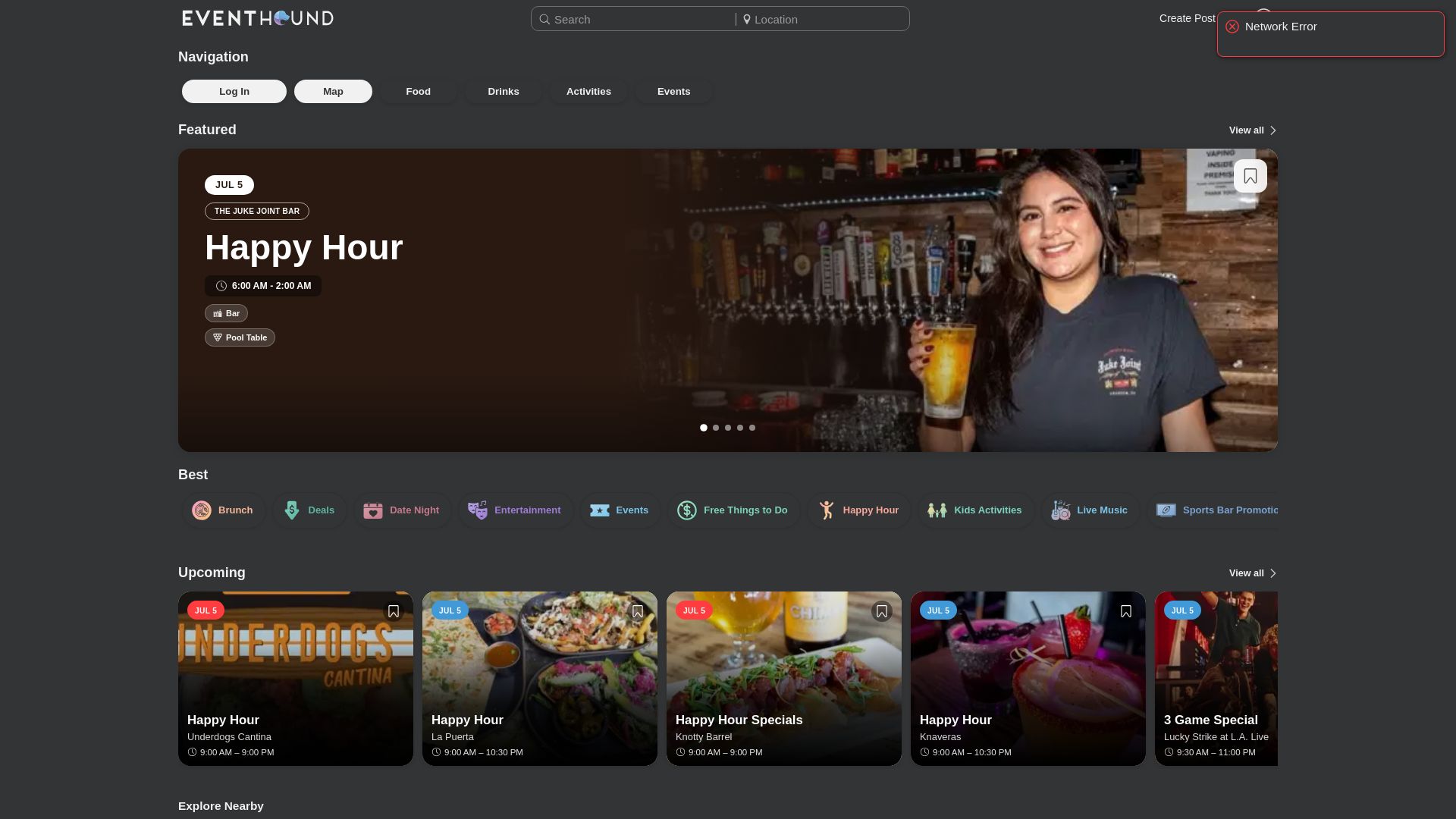
Here’s how local businesses use Eventhound to amplify partnerships:
- List co-hosted events on Eventhound so they appear in personalized local recommendations for people who have never heard of either business
- Promote partner offers and specials alongside your events, giving your collaboration a dedicated discovery destination
- Use platform analytics to see how many people viewed, clicked, or engaged with your listing, so you have real reach data to share with your partner
See how Eventhound works for local businesses and get your first joint event in front of a fresh local audience. You can also claim your business listing to start managing your presence on the platform today.
Sources
- How to Build Strong Community Partnerships for Growth | CO
- How Small Businesses Can Build Local Partnerships to Grow and Thrive - CPA Practice Advisor
- How business leaders and civic partners in small and midsized U.S. cities can advance racial equity and inclusive economic growth | Brookings