Fundraiser Event Ideas That Actually Raise Money
Fundraiser Event Ideas That Actually Raise Money
The fastest, most reliable fundraiser event ideas you can launch right now are peer-to-peer drives, benefit galas with a paddle raise, charity auctions, community A-thons, and hybrid virtual concerts. Each one has a proven track record across nonprofits, schools, and community groups of every size. Here is a quick comparison to help you pick one today:
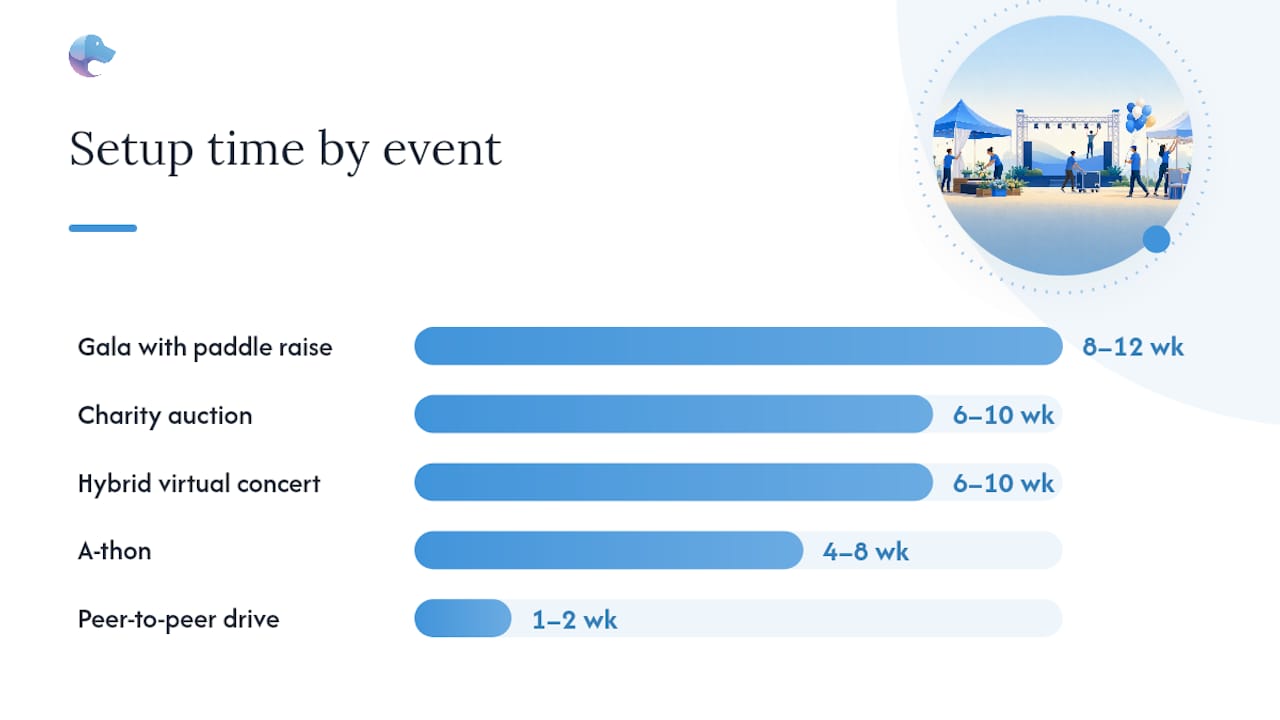
- Peer-to-peer drive — Supporters fundraise through personal pages; best for organizations with an engaged social network; expected revenue: high; setup time: 1–2 weeks.
- Gala with paddle raise — Ticketed dinner plus a live giving moment; best for mid-size to large nonprofits with a donor base; expected revenue: high; setup time: 8–12 weeks.
- Charity auction (live or silent) — Donated items drive competitive bidding; best for community groups and schools with local business connections; expected revenue: medium–high; setup time: 6–10 weeks.
- A-thon (walk, run, bike, read) — Participants collect pledges per unit of activity; best for schools, PTAs, and neighborhood groups; expected revenue: medium; setup time: 4–8 weeks.
- Hybrid virtual concert or benefit show — Live performance streamed online with in-person attendance; best for arts organizations and groups with a regional audience; expected revenue: medium–high; setup time: 6–10 weeks.
- Donation drive — Focused ask campaign (online or in-person) around a specific goal; best for urgent needs and small teams; expected revenue: low–medium; setup time: 1–3 days.
According to a 2025 sector report, 77% of nonprofits that held events met or exceeded their fundraising goals, with in-person and hybrid formats delivering the strongest returns. That number alone is reason enough to commit to an event rather than a passive online campaign.
Key Takeaways
The single most reliable path to a successful fundraiser is matching your event format to your donors’ preferences and your team’s actual capacity, not to tradition or convenience.
| Point | Details |
|---|---|
| Top formats by ROI | Peer-to-peer drives, galas with a paddle raise, and charity auctions consistently deliver the highest returns for nonprofits and community groups. |
| 77% success benchmark | 77% of nonprofits that held events in 2025 met or exceeded their fundraising goals, with in-person and hybrid formats leading. |
| Planning lead time | Most one-off events need 8–12 weeks; urgent campaigns can launch in 48 hours using peer-to-peer and personal outreach. |
| Legal first step | Check your state’s charity solicitation registration and raffle permit rules before committing to any format; requirements vary significantly by state. |
| Eventhound for promotion | Listing your event on Eventhound puts it in front of local audiences actively searching for things to do, increasing walk-in attendance and sponsor visibility. |
Three actions to take this week:
- [ ] Pick one event format from the shortlist or category bank above.
- [ ] Build a 6–8 week timeline using the milestone table in the planning section.
- [ ] Reach out to two potential sponsors or corporate partners with the pitch template above.
Table of Contents
- Why these fundraiser formats consistently outperform the alternatives
- A full bank of charity event ideas, organized by category
- How to pick the right fundraiser for your group
- Planning timeline and sample budget for your fundraiser
- How to promote your event and sell more tickets
- Legal, permits, and risk checklist for U.S. fundraisers
- How to raise a lot of money fast: the urgent playbook
- Ready-to-copy templates for event outreach
- The case for designing events donors actually want
- Authoritative U.S. sources and recommended reading
Why these fundraiser formats consistently outperform the alternatives
The shortlist above is not arbitrary. Each format earns its place because of how it handles three variables that determine event success: donor motivation, cost structure, and the ability to scale up or down without breaking the plan.
Peer-to-peer drives work because they transfer the ask from the organization to trusted friends and family. A donor who ignores an email from a nonprofit will often give $50 when a college roommate personally asks. The cost is almost entirely in platform fees and coordination time, which keeps margins high. Research consistently places peer-to-peer among the highest-ROI event types for mid-size organizations, especially when the cause has a personal story attached.
Galas with a paddle raise are the workhorse of mid-size nonprofit fundraising. The ticket revenue covers most costs, and the paddle raise (a live, tiered ask during the program) generates the real margin. A well-run paddle raise at a medium-sized dinner can net a substantial amount in under ten minutes. The key is setting giving levels intentionally, not defaulting to round numbers. BetterUnite’s aggregated event data shows that redesigning the paddle raise and making mobile giving frictionless with QR codes are the two highest-impact moves an organizer can make.
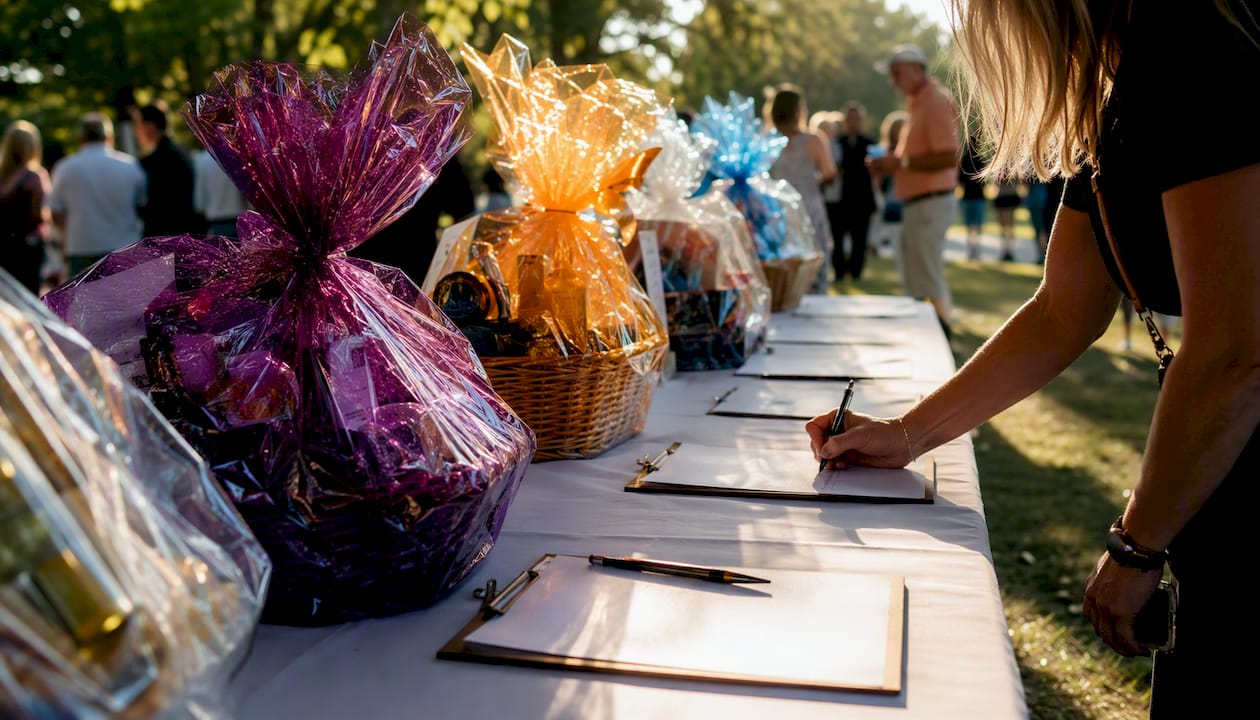
Charity auctions tap competitive instincts. Silent auctions work well alongside galas or community dinners; live auctions require a skilled auctioneer but can dramatically increase per-item revenue. The main risk is procurement: if your donated items are weak, bidding stalls. Build your item list before you commit to the format.
A-thons are the most accessible format for schools and neighborhood groups because participants self-fund through their own networks. A school read-a-thon can run with zero venue cost and minimal staff. Revenue scales directly with participant count, so the ceiling is high if the school community is engaged.
Hybrid virtual concerts expanded dramatically during the pandemic and never fully retreated. The hybrid model captures ticket revenue from an in-person crowd plus streaming donations from a much wider geographic audience. For arts organizations, it also serves as a cultivation event for major donors who want to see the mission in action.
Donation drives are the fastest to launch and the most flexible. They work best when tied to a specific, urgent goal (“We need $5,000 by Friday to fund the after-school program”). The urgency creates a natural deadline that motivates giving. Revenue potential is lower than event-based formats, but the effort-to-return ratio is hard to beat for small teams.
A full bank of charity event ideas, organized by category
The shortlist covers the proven anchors. The categories below give you the full range of creative fundraising ideas so you can match format to your specific audience, budget, and timeline. For each idea, the microformat reads: best for / cost & effort / expected revenue / one execution tip.
Organizations and hospitals publish extensive idea lists that organizers commonly use as references—from children’s hospital fundraising guides to FRA’s compiled event list. The categories below distill the formats with the strongest practical track records.
Virtual and hybrid events
- Online giving day — Best for any organization with an email list; cost & effort: low; revenue: medium–high. Set a 24-hour window, a matching gift challenge, and a specific dollar goal.
Recurring and ongoing fundraisers
- Monthly giving program — Best for any organization with a donor base; cost & effort: low (setup); revenue: high (compounding). Predictable revenue; donors give more over time than one-time givers.
How to pick the right fundraiser for your group
The best fundraiser is the one your donors will actually show up for, not the one your board is most comfortable running. Start there.
Here is a decision checklist to narrow your options:
- Who are your donors, and what do they enjoy? A crowd of retirees and a crowd of young professionals will respond to completely different events. Survey your top 20 donors before you pick a format.
- What is your volunteer capacity? A golf tournament requires months of coordination and a large volunteer team. A peer-to-peer drive can run with two people and a good email list.
- What is your budget for upfront costs? Some events (galas, golf tournaments) require significant deposits before a dollar comes in. If cash flow is tight, start with a low-cost format.
- What is your timeline? Eight weeks is the minimum for a gala. A donation drive can launch in 48 hours.
- Do you have a sponsor network? Corporate sponsors can cover production costs and flip a break-even event into a profitable one. If you do not have those relationships yet, choose a format that does not depend on them.
- What is your revenue goal, and is it realistic for this format? A bake sale will not raise $50,000. A gala might. Match the format to the number.
- Have you run this format before? First-time events almost always underperform projections. Build in a 20–30% revenue buffer when setting goals.
Red flags to watch for:
- High venue and catering costs that consume more than 30–40% of projected revenue before a single ticket is sold.
- Relying on donated auction items from businesses you have not already confirmed. Procurement falls through constantly.
- Planning a large gala with a volunteer team of fewer than ten people.
- Choosing a format because “we’ve always done it this way” rather than because your donors asked for it.
Pro Tip: Design the donor experience before you design the event logistics. Ask yourself: what will a first-time attendee feel at the 30-minute mark? If the answer is “confused” or “bored,” redesign the program before you book the venue.
Planning timeline and sample budget for your fundraiser
A 12-week timeline covers most one-off events comfortably. A 6–8 week timeline is workable for smaller, lower-complexity events. Anything under four weeks requires the urgent playbook in the next section.
Timeline milestones
| Timeframe | Track | Key milestones |
|---|---|---|
| Weeks 12–10 | Standard | Set goal, choose format, confirm venue, identify key sponsors |
| Weeks 9–7 | Standard | Secure lead sponsor, open ticket sales, launch P2P pages if applicable |
| Weeks 6–4 | Standard | Press release, social campaign launch, confirm entertainment/speakers |
| Weeks 3–2 | Standard | Final sponsor confirmations, email reminders, confirm permits |
| Week 1 | Standard | Final headcount, staff briefing, day-of logistics locked |
| Weeks 8–6 | Accelerated | Set goal, confirm venue, open ticket sales, identify sponsors simultaneously |
| Weeks 5–3 | Accelerated | Compressed promotion sprint, confirm all logistics |
| Weeks 2–1 | Accelerated | Final outreach, permits, day-of prep |
| Weeks 4–3 | Urgent | Peer-to-peer or donation drive only; skip venue-dependent formats |
| Weeks 2–1 | Urgent | Heavy social and email push; corporate match if available |
Sample event budget (mid-size gala, 150 guests)
| Line item | Estimated cost | Notes |
|---|---|---|
| Venue rental costs vary widely depending on location and arrangements. | Negotiate in-kind or reduced rate for nonprofits | |
| Catering costs per person vary based on menu and location. | $6,000–$12,000 total; largest single cost | |
| Audio/visual costs depend on equipment and service needs. | Includes QR code mobile giving setup | |
| Printed materials costs vary with quantity and design. | Program, signage, bid sheets | |
| Entertainment costs depend on the type and duration of performance. | Band, DJ, or emcee | |
| Ticketing platform fees typically represent a small percentage of ticket revenue. | Varies by platform | |
| A contingency budget is advisable to cover unforeseen expenses. | Non-negotiable line item | |
| Total estimated cost | $10,200–$25,000 | |
| Ticket revenue (150 × $100) | $15,000 | Covers most costs |
| Paddle raise (target) | $20,000–$40,000 | The real margin driver |
| Auction revenue | $5,000–$15,000 | Depends on item quality |
| Projected net | $25,000–$45,000 | After costs |
Milestone checklist:
- [ ] Venue contract signed (Week 10)
- [ ] Lead sponsor confirmed (Week 9)
- [ ] Permits applied for (Week 8)
- [ ] Ticket sales live (Week 8)
- [ ] Sponsorship packages sent (Week 8)
- [ ] Press release distributed (Week 6)
- [ ] Mobile giving QR codes tested (Week 2)
- [ ] Day-of run-of-show finalized (Week 1)
Pro Tip: Set your paddle raise at a few giving levels, with amounts ranging from accessible to aspirational for your attendees. The anchor makes mid-level gifts feel modest, which drives participation up the ladder.
How to promote your event and sell more tickets
The single most effective promotional combination for local fundraisers is local partner outreach plus a targeted email campaign plus social media with a mobile giving link. None of those three alone is enough.
Promotion checklist
- Local partner outreach (Weeks 8–6): Contact churches, schools, civic clubs, and neighborhood associations. Ask them to share the event in their newsletters and social feeds. These warm audiences convert far better than cold social ads.
- Email campaign (Weeks 6–1): Send a save-the-date, a ticket launch email, a mid-campaign update, and a final reminder 48 hours before the event. Keep each email to one clear ask. For practical email templates and segmentation timing, the email marketing playbook for local organizers covers the mechanics in detail.
- Social media (ongoing): Post 3–4 times per week on the platforms your donors actually use. Facebook still reaches older donors; Instagram and TikTok reach younger volunteers and participants. Use countdown posts, behind-the-scenes content, and donor spotlights.
- Community calendars and local blogs (Week 8): Submit the event to every free local listing you can find. A comprehensive list of free and local channels to list your event can double your organic reach without any ad spend.
- Board member and volunteer outreach (Week 6): Each board member should personally invite ten people. Personal invitations convert at a dramatically higher rate than mass emails.
- Press release (Week 6): Send to local newspapers, TV stations, and community blogs. A local news mention can add 20–50 attendees at zero cost.
- Peer-to-peer pages (Week 8): If your format includes P2P, launch participant pages early and give fundraisers a sample script and a goal.
Ticketing platform criteria
When choosing a ticketing platform, look for: mobile payment support (Apple Pay, Google Pay), a built-in event page, peer-to-peer fundraising capability, QR code generation for in-room giving, and transparent fee structures. For organizers comparing platform options, alternatives to Eventbrite for ticketed events breaks down the trade-offs across several tools.
Sponsor pitch checklist
When reaching out to corporate sponsors, include:
- A one-paragraph description of the event and expected attendance.
- Three tiered sponsorship packages (title, presenting, supporting) with specific benefits at each level (logo placement, table seats, social mentions).
- Your organization’s mission and a one-line impact statement.
- A deadline for the decision (sponsors need a reason to act now).
- A contact name and direct phone number.
For organizers in Southern California, sponsorship package templates and local examples offer a practical starting point for structuring your pitch.
Legal, permits, and risk checklist for U.S. fundraisers
Check state raffle and charity solicitation rules, food service permits, and local alcohol permits before you commit to any event format. Getting this wrong after you have sold tickets is expensive and embarrassing.
The IRS provides guidance on charitable solicitation and initial state registration requirements for charities. Most states require separate registration before you solicit donations from the public, and the rules vary significantly by state.
Legal and compliance checklist
- Tax receipts for donors: — Donors who give $250 or more must receive a written acknowledgment from your organization. For auction items, the deductible amount is the amount paid minus the fair market value of what the donor received.
Statistic callout: 77% of nonprofits that held events in 2025 met or exceeded their fundraising goals — but that success rate depends on organizations that planned ahead, including on the legal side.
Pro Tip: Create a simple spreadsheet to document every donated item: donor name, item description, estimated fair market value, and the date received. You will need this for tax receipts, auction disclosures, and your own records at year-end.
How to raise a lot of money fast: the urgent playbook
When you need funds quickly, focus on three things: peer-to-peer mobilization, a tight auction or paddle raise, and a corporate match or sponsor challenge. Everything else is secondary.
Day-by-day urgent fundraising plan (Days 0–7)
- Day 2: — Launch a peer-to-peer campaign. Give your five most connected supporters a personal fundraising page and a goal. Ask them to share it with their networks today.
Estimated time-to-funds by tactic
| Tactic | Time to first funds | Revenue potential |
|---|---|---|
| Personal email to top donors | 24–48 hours | Medium–high |
| Peer-to-peer campaign launch | 48–72 hours | High |
| Corporate match challenge | 48–96 hours | Medium–high |
| Social media crowdfunding post | 24–72 hours | Low–medium |
| Live event with paddle raise | Day of event | High |
| Text-to-give campaign | 1–24 hours | Low–medium |
Two cautions: First, donor fatigue is real. If you ran a campaign in the last 60 days, your response rate will be lower. Acknowledge the frequency in your ask (“We know we’ve been in your inbox recently — this one is urgent”). Second, tax receipt timing matters. Donors who give at year-end need receipts by January 31. If your urgent campaign runs in late December, have your receipt process ready before you launch.
Ready-to-copy templates for event outreach
Short, donor-centered copy with a single clear call to action outperforms long, organizational copy every time. Use these templates as starting points and customize the bracketed fields.
Email invite
Subject: You’re invited: [Event Name] on [Date]
Hi [First Name],
[Organization Name] is hosting [Event Name] on [Date] at [Location]. Every ticket sold goes directly to [specific program or impact].
Tickets are $[amount] and include [brief description of what’s included]. Space is limited to [number] guests.
[RSVP / Buy Tickets button or link]
Questions? Reply to this email or call [phone number].
Thank you, [Your Name], [Title]
Customization note: Replace the impact line with a one-sentence story about a real person your organization has helped.
Sponsor pitch email
Subject: Partnership opportunity: [Event Name], [Date]
Hi [Contact Name],
[Organization Name] is hosting [Event Name] on [Date], expecting [number] attendees from [community/region]. We are offering three sponsorship levels starting at $[amount].
As a [Level] sponsor, [Company Name] would receive [specific benefits: logo placement, table seats, social mentions].
I would love to connect this week to discuss. Are you available for a 15-minute call on [Day] or [Day]?
[Your Name], [Title], [Phone]
Customization note: Lead with the audience demographic your sponsor cares about most (age range, household income, community ties).
Facebook/Instagram post
🎉 [Event Name] is coming up on [Date]!
Join us at [Location] to support [cause in one sentence]. Tickets are $[amount] and every dollar goes to [impact].
Link in bio to grab yours. Tag a friend who should come!
#[YourOrg] #[CityName]Fundraiser #[CauseName]
Customization note: Post a real photo of your program in action rather than a generic graphic. Authentic images consistently outperform designed flyers on social.
SMS reminder (send 24 hours before event)
Hi [First Name]! Reminder: [Event Name] is tomorrow at [Time], [Location]. We can’t wait to see you. Questions? Reply here. [Org Name]
Customization note: Keep SMS under 160 characters if possible. One link maximum.
Donation receipt text
Dear [Donor Name],
Thank you for your gift of $[amount] to [Organization Name] on [Date]. No goods or services were provided in exchange for this contribution. [If auction: The fair market value of items received was $[amount]; your deductible contribution is $[difference].]
Your gift supports [one-sentence program description].
[Organization Name] | EIN: [XX-XXXXXXX] | [Address]
Customization note: Send within 48 hours of the gift. Donors who give $250 or more are legally required to have this documentation to claim a deduction.
The case for designing events donors actually want
The conventional wisdom in nonprofit fundraising is that a gala is the gold standard. It is not. It is the most expensive, most labor-intensive format available, and it often serves the planning committee’s preferences more than the donors’.
The data from organizations that have shifted to a donor-centered design approach tells a different story. Smaller, curated events built around what a specific donor segment actually enjoys — a cooking class for mid-level donors, a behind-the-scenes tour for major gift prospects, a neighborhood 5K for the broad community base — often reach more households and net higher combined revenue than one large gala. The gala tries to be everything to everyone. The targeted event is exactly right for the people in the room.
Two measurement habits separate the organizations that improve year over year from those that repeat the same event and wonder why results plateau. First, track participation rate on asks, not just total dollars raised. If 40% of your gala attendees responded to the paddle raise, that is a very different result than 15% responding at a higher average gift. Both numbers matter, and you need both to know what to fix. Second, capture post-event contact data and build a stewardship plan before the event happens, not after. The donors who attend your event and never hear from you again are the most expensive donors you have.
One practical trade-off worth naming: shorter events with curated guest lists almost always outperform longer events with open invitations. A 90-minute program with 80 highly engaged guests will raise more than a 4-hour program with 200 loosely connected attendees. Attention is the resource you are managing, not square footage.
Authoritative U.S. sources and recommended reading
A short list of primary references for organizers who want to go deeper on legal requirements, sector benchmarks, and planning tools:
- How to Plan Nonprofit Fundraising Events Your Donors Actually Want to Attend
- 7 Highest-ROI Fundraising Events for Mid-Sized Nonprofits in 2026
- Charitable solicitation and initial state registration (IRS)
- grants.gov
- Fundraising Event Ideas for Nonprofits (FRA PDF)
This article provides general information for planning purposes, not legal or tax advice. Confirm current permit requirements, solicitation registration rules, and tax receipt obligations with your state attorney general’s office or a qualified nonprofit attorney.